What MAIJU changes about measuring motor development
A clinic visit sees twenty minutes of a child in an unfamiliar room. MAIJU measures ordinary play at home, objectively and as often as a study needs — and the published evidence shows what that is worth.
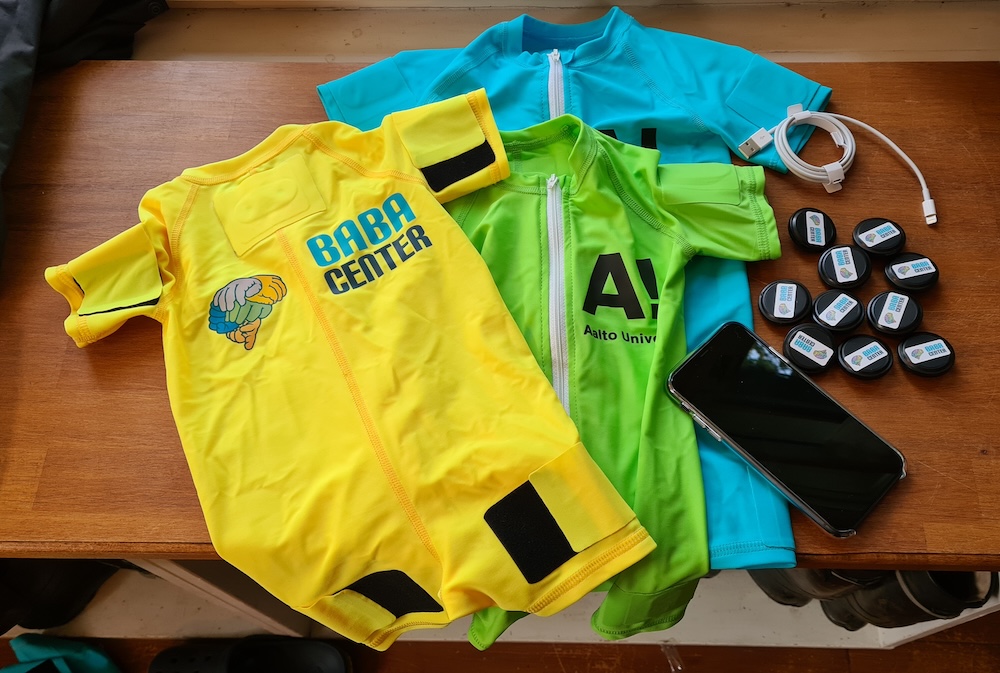
Gross motor development is one of the most closely watched parts of early childhood, and one of the hardest to measure well. The standard way is a visit: a trained assessor watches the infant for a short while in a clinic and scores what they see. That works, but it is a snapshot — taken in an unfamiliar room, limited by how often a family can come in, and scored by eye.
MAIJU takes the measurement to the child instead. Here is what that changes, with the evidence for each point.
It measures the ordinary day
The family puts the suit on at home and the infant plays as usual while four sensors record every movement. No assessor is in the room and no visit is needed. Published sessions average around two hours of free play, far more than any clinic observation (Sci Transl Med 2026), and the method works well outside a laboratory setting: in a concurrent validity study all 67 at-home measurements were technically successful (Dev Med Child Neurol 2026), and in rural Malawi 94% of 121 measurements were (Pediatr Res 2026).
It agrees with the clinical standard
The BABA Infant Motor Score condenses a recording into one number from 0 to 100. Compared with the Alberta Infant Motor Scale scored by an experienced paediatric physiotherapist, the two correlated at ρ = 0.97. Used to flag infants below the 5th and 10th centile, they agreed at κ = 0.81 — in a cohort where more than half the infants came from a neurodevelopmental follow-up clinic (Dev Med Child Neurol 2026).
It does not depend on who is watching
The analysis is automatic: every second of the recording is classified into postures and movements by an algorithm that matches the agreement two trained human annotators reach with each other (Commun Med 2022); with all four sensors, posture classification reaches a Cohen's κ of about 0.90 (JMIR mHealth uHealth 2025). The same recording always gives the same result, so a change between two visits is a change in the child rather than a change in the rater.
It follows a child over time
Because the score moves gradually rather than jumping between milestones, it can be repeated and plotted on a growth chart, the way height and weight are. In a direct comparison, a single motor measurement placed a child's development as precisely as a length measurement does (a spread of 1.4 months against 1.5), and more precisely than weight or head circumference (eBioMedicine 2023). The score also keeps rising after scales such as the AIMS have reached their ceiling (Dev Med Child Neurol 2026). The BIMS page shows one infant's trajectory against the normative chart.
It sees detail a score leaves out
Behind the single number is a second-by-second record: time in each posture, how the infant moves within it, how often they change position. From 580 recordings of 92 typically developing infants, 220 such metrics have been charted against age, and in an independent clinical cohort 55% of them separated infants with abnormal development from the rest (Sci Transl Med 2026).
It connects to development beyond movement
Motor development does not happen in isolation. In a longitudinal study of 107 infants, those whose motor maturity ran ahead of their age were also ahead in prelinguistic and social development (Pediatr Res 2025). That makes MAIJU a useful measure for studies whose main question is not motor development at all.
What it is not
MAIJU is not a diagnosis. It measures gross motor performance, in detail and over time; interpreting what a result means for a particular child remains a clinical judgement. It is built for infants from lying supine to walking fluently, and its published validation covers 4 to 22 months of age (Pediatrics 2025).
Every claim above comes from a peer-reviewed paper, and all of them are listed on the research page. If you are planning a study or a follow-up service, tell us what you want to measure.