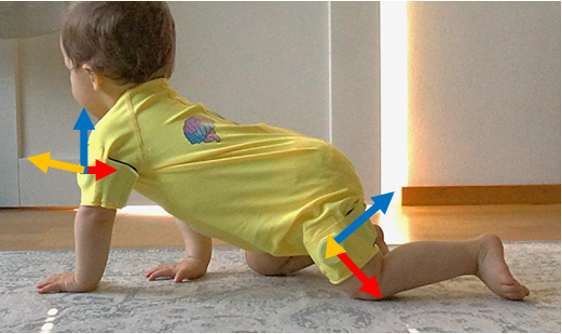
MAIJU
Jumpsuit for infant movement assessment
- Ages
- 4-24 months
- Sizes
- 68, 74, 80, 86 and 92 cm
- Publications
- 14 peer-reviewed
What it measures
Garments that hold movement sensors where the measurement needs them. The sensors detach, so one set serves every garment you own.
A wearable measurement is only as good as where the sensor sits and how firmly it stays there. Each Momega garment is designed around one kind of question — how an infant moves, or how an infant sleeps — and puts the sensors in the positions that are ideal for measuring said phenomena. The sensors themselves are the same Movesense® units in every garment.
Jumpsuit for infant movement assessment
What it measures
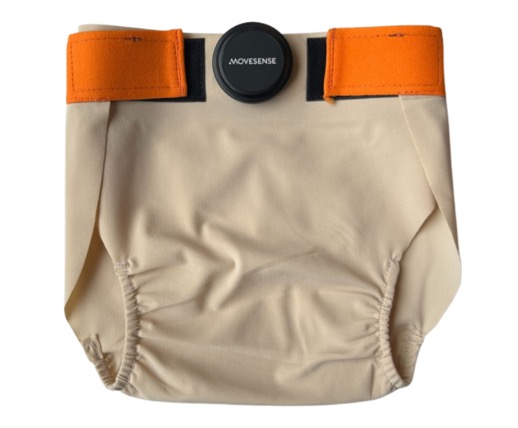
Diaper cover for infant sleep assessment
What it measures
| Property | MAIJU | NAPPA |
|---|---|---|
| Question | How is the infant's gross motor development progressing? | How does the infant sleep and breathe through the night? |
| Garment | Full-body suit, worn like ordinary overalls | Diaper cover, worn over the infant's own diaper |
| Sensors | Four, one on each limb, in proximal lateral pockets | One, at the front of the waist |
| Recorded | During the day, in free play at home — an hour or more | During sleep — overnight and naps, at home |
| Main outputs | BABA Infant Motor Score, gross motor growth charts, posture and movement profile | Sleep and wake states, respiration rate, body position and activity |
| Key validation | ρ = 0.97 against the Alberta Infant Motor Scale scored by a paediatric physiotherapist (Dev Med Child Neurol 2026) | 78% sleep-state accuracy against polysomnography in 33 infants aged 2 weeks to 18 months, comparable against human inter-rater agreement (Heliyon 2024) |
| Ages | 4–24 months, from lying supine to walking fluently | 0–24 months |
Planning a study that needs both? The two garments use the same sensors and the same app, so one set of electronics covers days and nights.
One set of Movesense® sensors serves every garment you own. A study that follows infants from motor development into sleep, or from one age group into the next, does not need a second set of electronics.
Sensor placement decides which analyses are possible, so the garment — not the hardware — is what you choose for each study. The published analyses are validated for the positions each garment uses.
Garments, sensors and Tessalogger give you the raw recordings on their own. Cloud analytics turns them into validated measures, and you can add it at any point.
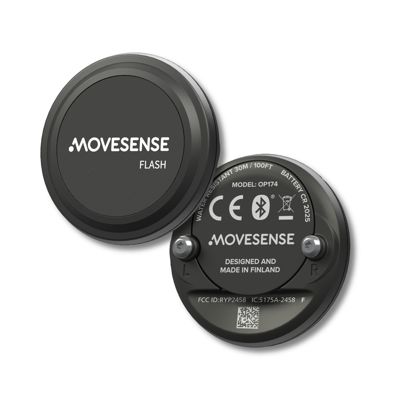
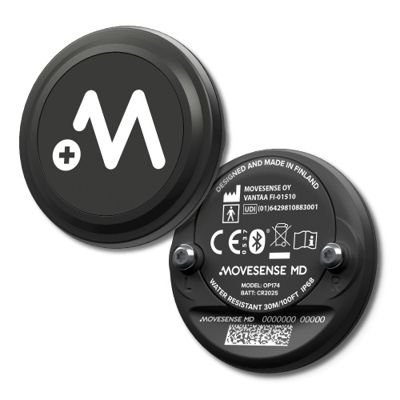
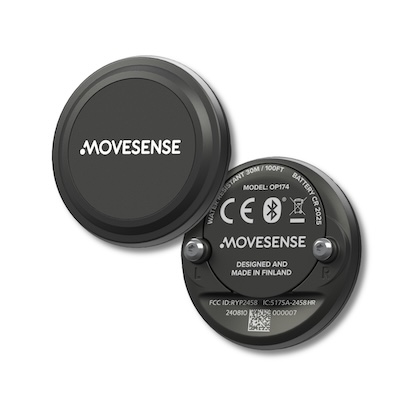
All Momega garments carry Movesense® sensors made by Movesense Ltd: coin-sized inertial measurement units that record tri-axial acceleration and angular velocity. They can be bought with the garments or separately. The two models differ mainly in where the data goes during a recording: Movesense MD streams it live to the phone, while Movesense Flash has a larger memory for keeping it on the sensor, ensuring better data quality. Batteries sold separately.
Recommended. Large memory version of the Movesense sensor. Streaming not required.
Medical Device version of the Movesense sensor. Streaming required for MAIJU.
Basic version of the Movesense sensor. Cheapest option. Streaming required for MAIJU.
With Movesense MD or HR2, the datalogging phone or tablet needs to be within Bluetooth range, in practice in the same room, to collect data. In the largest published MAIJU dataset, an unstable Bluetooth connection — usually the phone being left away from the infant — was the most common reason a home recording failed. Movesense Flash is a sensor that stores the data in its own memory and downloads it afterwards, removing the constraint (Science Translational Medicine 2026).
Tessalogger is the mobile app that runs the recordings, for iOS and Android. It is included with every garment purchase; you provide the phone or tablet.
Fit matters more here than in ordinary clothing. A loose garment lets a sensor rotate or slide, and the analyses read that as the infant's own movement, so each garment should be snug at the sensor positions while leaving the child free to move.
Step-by-step fitting is on the instructions page.
MAIJU is made from a polyamide–elastane knit of the kind used in swimsuits: it stretches to fit different body shapes, transports moisture, and was chosen to tolerate repeated laundering. Take the sensors out first, machine wash with a detergent for synthetic materials, and check the pockets and seams for wear before the next use.
NAPPA is a pull-up textile diaper cover with the sensor mount laminated between its layers; Made from the same material as MAIJU. Remove the sensor before washing.
Both garments are machine washable at 40 °C with standard detergents. Expected number of wash cycles for both garments is 50.
PLACEHOLDER — minimum order, lead time, shipping regions, and customs outside the EU.
Not sure which garment fits your protocol? Tell us what you want to measure and the ages of the participants in the quote request, and we can usually answer in one reply.