Movesense MD
Medical Device version of the Movesense sensor. Streaming required for MAIJU.
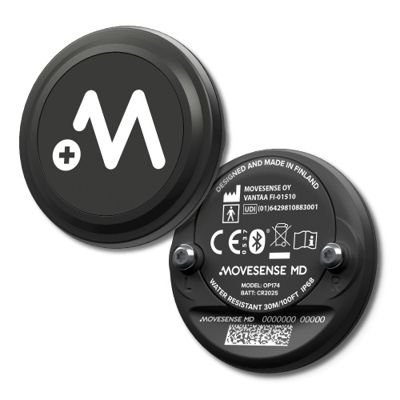
- Choose for
- Studies whose protocol or procurement requires a certified medical-device sensor
- Recording
- Streams to Tessalogger over Bluetooth; the phone must stay within range
- Motion sensors
- Accelerometer ±2–16 g, gyroscope ±125–2000 °/s, magnetometer ±49 gauss; 12.5–208 Hz, ±2% accuracy
- Used by Momega analyses
- Accelerometer and gyroscope at 52 Hz, as in the published studies
- Memory
- 3 Mbit (384 kB) EEPROM
- Battery
- CR2025 coin cell, user replaceable. A full day (12–24 h) of continuous streaming in the published protocol, depending on battery brand and Bluetooth conditions.
- Size and weight
- 36.6 mm diameter, 10.6 mm thick; 9.4 g with battery
- Water resistance
- 30 m; IP68, shock resistant
- Regulatory
- Class IIa medical device under EU MDR 2017/745; made under ISO 13485
Movesense MD is the medical-device version of the Movesense sensor. It measures acceleration and rotation with the same kind of motion sensor as the other models, but it is certified as a Class IIa medical device under the EU Medical Device Regulation, manufactured under an ISO 13485 quality system, with firmware developed to IEC 62304. Some clinical studies and hospital procurement processes require exactly that.
The MDR certification belongs only to the sensor as a measuring device. It does not by itself make a MAIJU or NAPPA recording, or the analyses computed from it, a medical device. All Momega gaments carry a normal CE tag, and do not as of yet possess Medical Device Regulation status. We are working hard to eventually deliver MDR versions of our products.
When to choose it
Choose Movesense MD when your protocol, ethics approval or purchasing rules call for a certified medical-device sensor. For other home recordings we recommend Movesense Flash, because MD has to stream.
Its memory is 384 kB — enough for minutes of movement data at the rates MAIJU uses, not a full session — so the data goes live over Bluetooth to Tessalogger, and the phone or tablet has to stay within range, in practice in the same room as the infant, for the whole recording. In the largest published MAIJU dataset, a lost Bluetooth connection was the most common reason a home recording failed (Science Translational Medicine 2026). With an MD sensor, keeping the phone close is the one instruction a family most needs to follow.
With NAPPA this sensor does not need to stream. For sleep recordings the sensor computes the sleep measures itself and stores them, and the published NAPPA studies logged three 12-hour nights in this memory before downloading (Heliyon 2024). Streaming is needed for MAIJU, which records the raw movement signal.
In use
- Prepare. Check the battery level of each sensor in Tessalogger, and replace the coin cell if it is low.
- Record. Clip the sensors into the garment in the orientation the instructions show, start the recording, and keep the phone or tablet in the same room throughout.
- Collect. The data is already on the phone when the session ends, ready to export or upload for analysis.
The sensor also carries a magnetometer and a single-channel ECG, which Momega's garments and analyses do not use. Specifications are from Movesense and the Movesense Medical data sheet; see the garments page for how the sensor models compare.