Movesense Flash
Recommended. Large memory version of the Movesense sensor. Streaming not required.
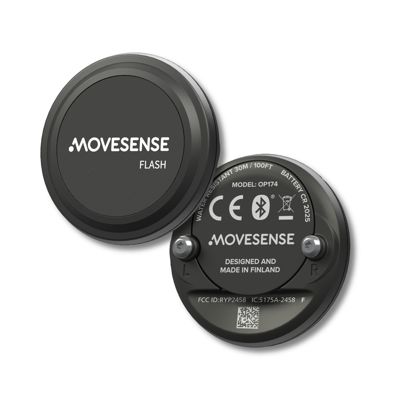
- Recommended for
- MAIJU and NAPPA recordings at home
- Recording
- Logs to its own 128 MB flash memory; downloaded to Tessalogger after the session
- Motion sensors
- Accelerometer ±2–16 g, gyroscope ±125–2000 °/s, magnetometer ±49 gauss; 12.5–416 Hz
- Used by Momega analyses
- Accelerometer and gyroscope at 52 Hz, as in the published studies
- Battery
- CR2025 coin cell, user replaceable. One cell lasted a full day (12–24 h) of continuous streaming in the published protocol; logging to memory draws less.
- Size and weight
- 36.6 mm diameter, 10.6 mm thick; 9.4 g with battery
- Water resistance
- 30 m
- Radio
- Bluetooth 5.1 Low Energy
- Compliance
- CE; REACH and RoHS
Movesense Flash is the sensor we recommend for recordings at home. It measures the same movement signals as the other Movesense models, but writes them to 128 MB of memory inside the sensor instead of streaming them to a phone. The recording no longer depends on a live Bluetooth connection, and the phone or tablet does not have to stay near the infant.
Why it is the recommended sensor
A sensor that streams needs the phone within Bluetooth range for the whole session — in practice, in the same room. At home that is hard to guarantee: the infant crawls to the next room, a parent takes the phone along. In the largest published MAIJU dataset, an unstable Bluetooth connection was the most common reason a home recording failed. A sensor that stores its data itself and downloads it afterwards removes that failure mode (Science Translational Medicine 2026).
It also makes the recording simpler for the family. The phone is needed to start the session and to collect the data at the end, not to watch over it.
In use
- Start. Pair the sensors in Tessalogger and start the recording; each sensor begins logging to its own memory.
- Record. Clip the sensors into the garment — four in a MAIJU suit, one per limb, or one in NAPPA — in the orientation the instructions show. The phone can be put away.
- Collect. After the session, bring the sensors near the phone and Tessalogger downloads the data, ready to export or upload for analysis.
The Flash sensor can fit up to 4 days (96 hours) worth of data using the lowest 13 Hz sampling rate. Download and clear the memory between recordings.
The sensor also carries a magnetometer and a single-channel ECG, which Momega's garments and analyses do not use. Specifications are from Movesense; see the garments page for how the sensor models compare.